
ESTIMATION OF SAMPLE SIZE AND POWER ANALYSIS FOR CLINICAL RESEARCH STUDIES

ROLE OF BIOSTATISTICIAN AND BIOSTATISTICAL PROGRAMMING IN EPIDEMIOLOGICAL STUDIES
July 17, 2020
Guidelines on Virtuous Pharmacovigilance Practices
December 18, 2020In brief
- Clinical research studies the effect of an intervention on a specific population or the causation-association between a predicting variable and a health condition.
- The results of these studies are analysed by scientific statistical methods and statistical significance is determined.
- Starting with an adequate sample size is an important prerequisite to obtain accurate results and outcomes as determined statistically.
- Power analysis is widely recommended as a method for estimation of adequate sample size.

Clinical research and sample size
Clinical research services involves studying the effect of an intervention on a specific group of people with the condition under study. The study is conducted on a sample group of people and the results are extrapolated to the entire population. Hence, selection of inadequate sample size influences on the final outcomes and is an important determinant of the appropriateness of the methodology and Clinical study design.
If the sample size is too small, it may fail to detect significant associations and outcome of the research study, if any, becomes questionable for application to the entire population. And if the sample size is too large, the time, energy, and money required for the study is unnecessarily increased. Also, if the sample size is too large, it may also influence the accurateness of the outcome of the study. Thus, to achieve the desired outcome of any research study, i.e. to be able to get statistically significant outcomes that can be extrapolated to the entire population, an optimum sample size is a must. Statistical analysis planning for clinical trial involves use of power analysis for estimating desired sample size in a research study. Scientific medical writing services provide sample size calculations and power analysis support in the process of study designing.
Statistical analysis
Every research study begins with a hypothesis or an assumption called the null hypothesis or the research question. This is done to be able to apply statistical tests. Power analysis is done to estimate the required sample size to prove or disprove the null hypothesis or research question. During statistically analysis, two types of errors are possible. Type I error occurs when the null hypothesis is rejected incorrectly while type II error occurs when the null hypothesis is accepted incorrectly. Sample size estimation by power analysis is done to avoid both type I and type II errors.
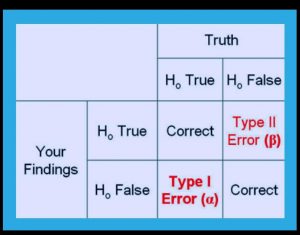
This is done by determining the p value, which is the probability of obtaining a test statistic as large or larger than obtained in the study by chance if the null hypothesis is true. α is the predetermined level of statistically significance. The null hypothesis is rejected if they obtained p value is less than α and the null hypothesis is accepted if the p value is greater than α.
Power analysis and sample size estimation
Sample size is determined by: –
- Hypothesis – The research question is formulated in the form of the null hypothesis and alternate hypothesis. Alternate hypothesis can be one-sided or two-sided. A two-sided hypothesis requires a greater sample size as compared to one sided hypothesis.
- Effect size – If the association between the variable under study and the
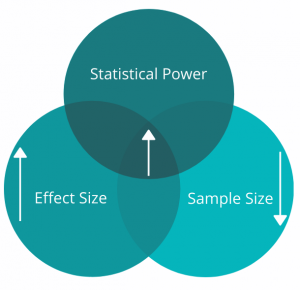
outcome is strong, then a smaller sample size can pick up the association. However, if the association between the variable under study and the outcome is weak, then a larger sample size is required to pick up the association. To know this, one requires to study prior research done on the subject. If adequate material is not available, then one should consider doing a pilot study prior to taking up the research project.
- Level of statistics significance – The researcher along with the statistician should establish the acceptable probability of making type I error (α)and type II error (β). Type I error is serious and the aim of statistically analysis is to avoid type I error. So, the level of significance is usually set at α = 0.05. As the significance criterion becomes more precise, the sample size required to pick up the association increases.
- Power – Power refers to the sample size required to avoid type II error and probability to avoid this error is the statistical power of the study.
Sample size calculation
The above four factors are used to calculate the sample sizealong with the null and alternate hypothesis and the statistical test chosen.Statistically analysis is then carried out by the statistician using standard textbooks or computer software programs. Medical writing companies provide power analysis and sample size estimation support.
Maximize the power with minimum sample size
- The sample size calculated should be a practical number and feasible for the Clinical research study. Continuous variables can be used for smaller sample sizes.
- In cohort studies, taking two measurements, one at the beginning and the other at the end of the study can be used for sample size calculation.
- Studying few precise variables with same or similar outcome helps to derive conclusions with a smaller sample size.
Sample size calculation should be done before during or after the study
Ideally sample size should be estimated prior to the study. Occasionally it is done during or sometimes even after the study. To make any research study worthwhile, efficient, and cost effective, it is best to design the study properly with respect to sample type and sample size. This is often based on assumptions made at the beginning of the study.
These may need to be revisited during the study however in an unbiased fashion and the research study should be completed unless interim results show extremely harmful effects on the subjects.
In case the research study yields negative results, one should revisit the sample size ensure that the study was not underpowered resulting in a type II error.
And so,
Researchers should use power analysis and statistically analysis support to predetermine an effective sample size to make the study worthwhile.
References
- Zodpey SP. Sample size and power analysis in medical research. Indian J Dermatol Venereol Leprol. 2004;70(2):123-128.
- Osborn JF. Minimising errors in clinical studies by proper selection of sample size. Ann Acad Med Singapore. 1991;20(1):95-100.
- Carneiro AV. Estimating sample size in clinical studies: basic methodological principles. Rev Port Cardiol. 2003;22(12):1513-1521.
- Jones SR, Carley S, Harrison M. An introduction to power and sample size estimation. Emergency Medicine Journal 2003;20:453-458.
- Rao UK. Concepts in sample size determination. Indian J Dent Res [serial online] 2012 [cited 2020 Jul 22];23:660-4. Available from: http://www.ijdr.in/text.asp?2012/23/5/660/107385
- Browner WS, Newman TB, Hulley SB. Getting Ready to Estimate Sample Size: Hypotheses and Underlying Principles. In: Cummings SR, Browner WS, Grady D, Hearst N, Newman TB, editors. Designing Clinical Research: An Epidemiologic Approach. 2nd ed. Philadelphia: Lippincott Williams and Wilkins; 2001. p. 76